JR Solonche in Offcourse: inspired by Chinese poetry

JR Solonche is a man of literature. He expresses his love of literature with many forms, more than I can say I know. Read this wonderful verse in Offcourse, penned out of simple love.

One of my favorites posted here; go to the link to read the other four.


THE BEGGING CUP

(After an Anonymous Chinese Poem)

A handful of clay
and a birch twig
for a handle.

Be grateful
for whatever
falls in.

Look.
These words
are first.


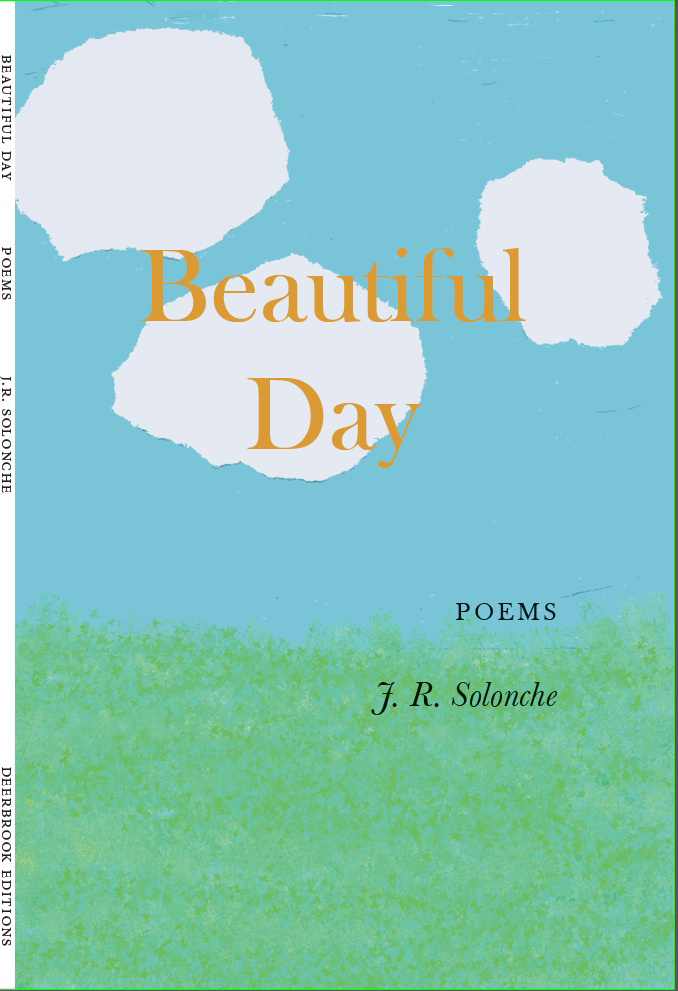
Five-time Pushcart as well as Best of the Net nominee, J.R. Solonche has been publishing poetry in magazines and anthologies since the early 70s. He is coauthor of Peach Girl: Poems for a Chinese Daughter (Grayson Books) and author of Beautiful Day(Deerbrook Editions) and Heart’s Content (Five Oaks Press). He lives in New York’s Hudson Valley with his wife, the poet Joan I. Siegel and nine cats, at least three of whom are poets.
His work has appeared frequently in Offcourse.

Beautiful Day

JR Solonche returns to the Lake

A couple of poems in December’s The Lake Journal: The Lake poetry

Jacob and the Angel

Afterward in the morning,
already late in the morning,
already near noon,
he awoke,
and no one was about.
His right hand was gripped tightly
on the shin of his leg.
His left arm was under his head
so that the elbow was stiff,
and the forearm was numb
from the weight of his head upon it.
His mouth was dry with the dryness of sand,
and the lips of his mouth were parched as the sand of the desert.
He felt the soreness in his limbs.
He felt the stiffness in the joints of his limbs.
He saw the full light of day illuminating the tent.
The flap of the tent opening was bright with the brightness of daylight.
And even full with soreness in his body,
and even full with stiffness in his limbs,
and even full with a terrible thirst in his mouth, he sprang to his feet,
and he threw himself upon the tent opening,
upon the full light of the tent opening that flapped like white wings in the dry wind.

The Jonah Story

I do not like the Jonah story.
The Jonah story is all
obedience and disobedience,
God calling on the wind
to frighten the sailors,
God calling on the whale
to swallow up Jonah
and spit him out again
on dry land, God
calling on the worm
to desolate the vine.
The Jonah story is all God
calling. I do not like the way
the Jonah story ends.
The Jonah story ends
without ending. It ends
with God asking
Jonah a question,
but really asking one of those
holy rhetorical questions
that God is so fond of,
and that is where Jonah is
left hanging,
on the question mark of God.
And I do not like this because
I want to know what happens
to heroes at the end of stories.
What happens to Jonah
at the end of his story?
What does Jonah do?
Does he go home?
Does he stay where he is
on the east side of Nineveh
where he prepares a field
of gourd vines? Does he
sleep twenty-four hours through?
Does God leave Jonah alone?
Does God leave Jonah alone,
finally, oh finally,
in the shade of the vine?

J.R. Solonche has been publishing in magazines, journals, and anthologies since the early 70s. He is author of Beautiful Day (Deerbrook Editions) and coauthor ofPeach Girl: Poems for a Chinese Daughter (Grayson Books). He lives in New York’s Hudson Valley with his wife, the poet Joan I. Siegel, and nine cats, at least three of whom are poets.

After the Rehersal

Wind drives leaves across the road.
Mozart’s Requiem remains in my mind’s ear.
It remains in my ear’s mind and has become a tree of human voices.
The wind drives the leaves across the road, ahead, in my car’s beam.
I hear the tree of voices die.
I hear it fall away voice by voice in the wind.
The tree is bare but for the boom of one last leaf-voice.
Then that too joins the wind as I open the door of the laundry room.

by J.R. Solonche
author of Beautiful Day
Deerbrook Editions, 2015
Beautiful Day

This is one of a few poems J.R. sent not in the collection that is Beautiful Day.

A review of Beautiful Day that appeared in The Lake.

Another poem delighted in on Wherewithall.

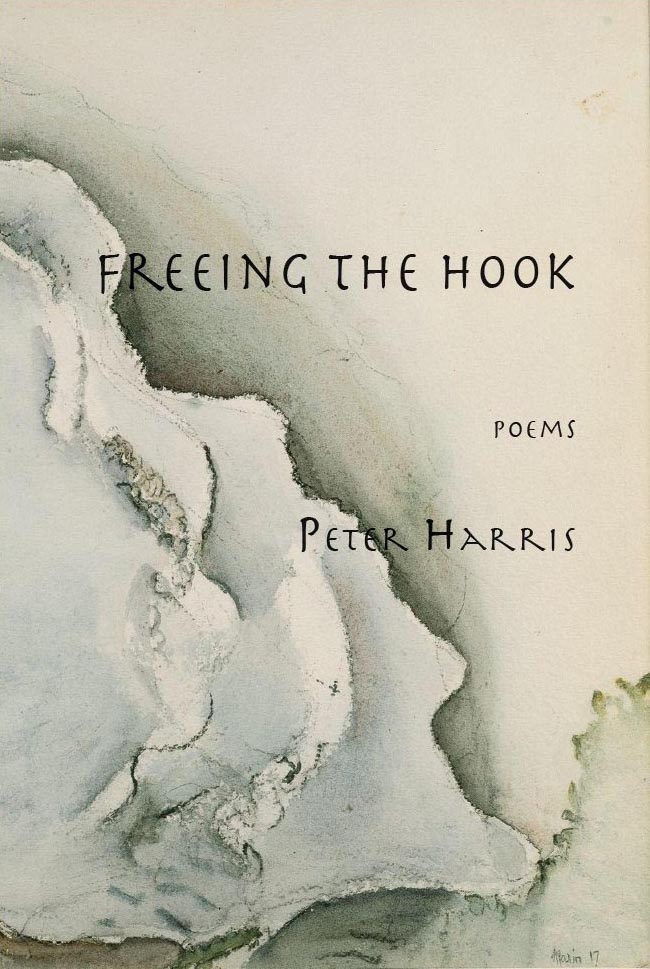
Freeing the Hook, poetry by Peter Harris

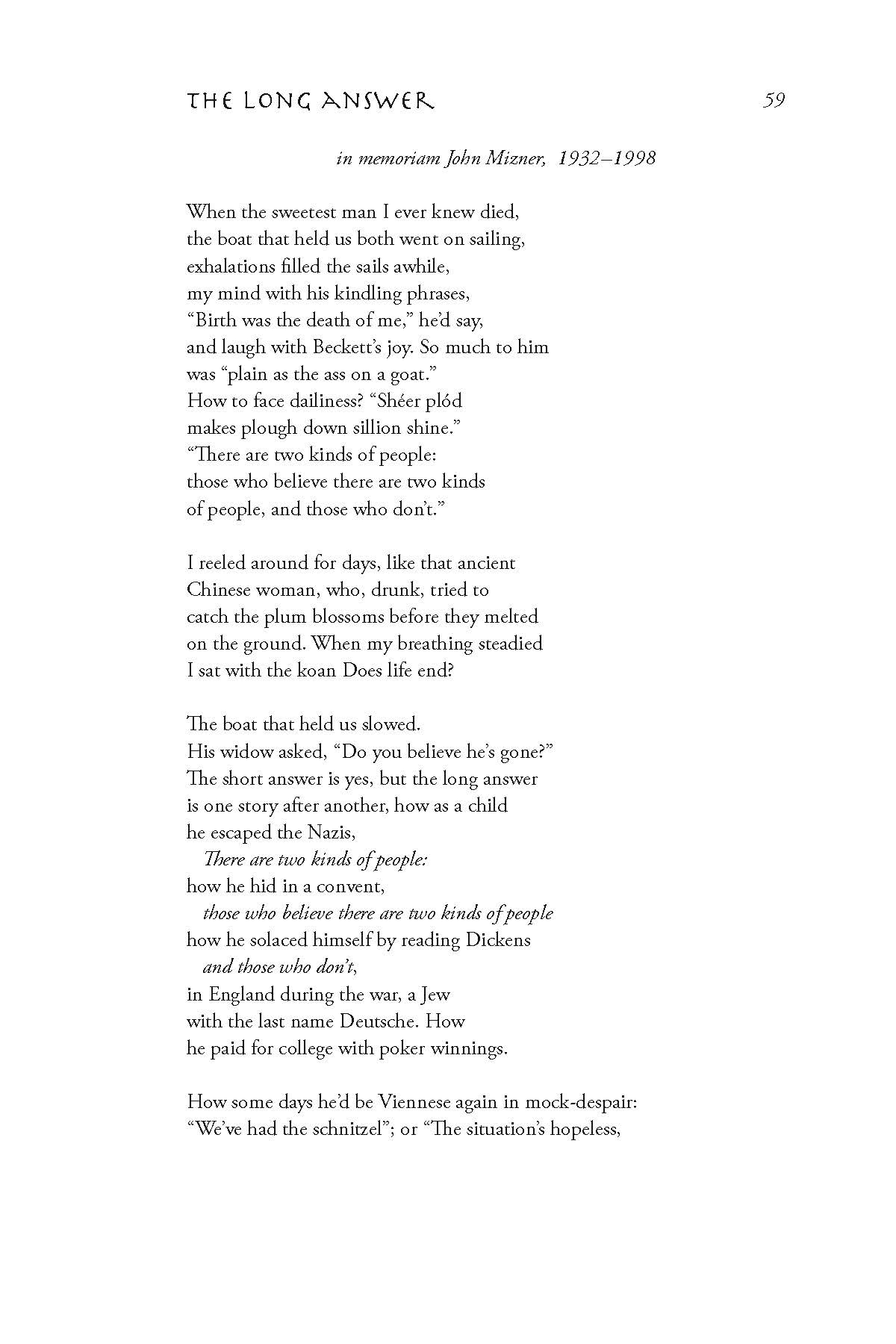
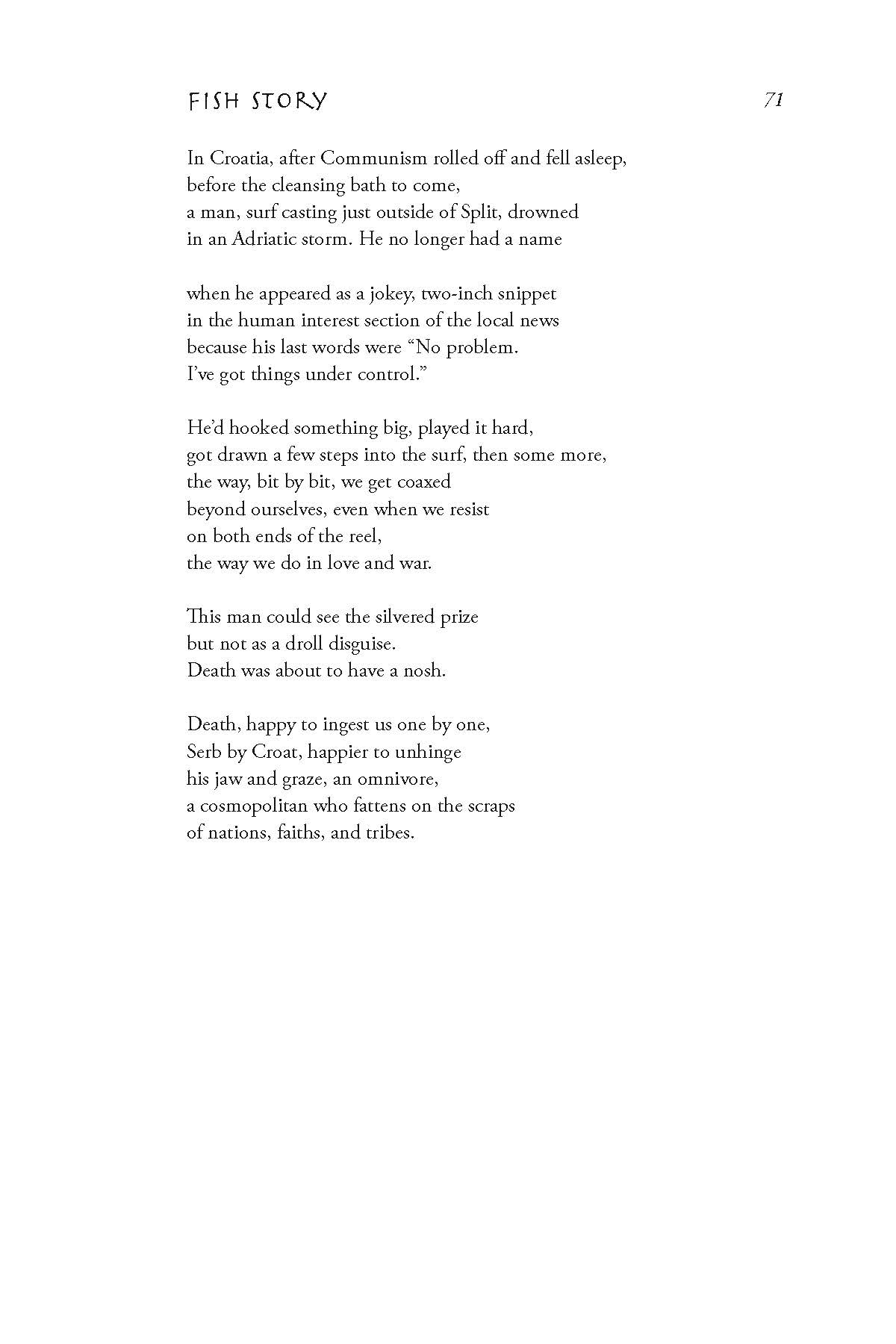
Here are two favorite poems from Freeing the Hook by Peter Harris. Although this title has been out for a couple of years I want to bring attention to the work because books don’t get discovered without this posting, and it seems folks want to see the work, so what better way then to put pages up.

Peter is a special poet that writes from the heart. These are a couple of sentences from the back cover:

Freeing The Hook takes you on a backstage tour of love, death, family and solitude. Their dark, inquisitive, tender humor is our immunization. Their stubborn compassion is our salvation.

—Tony Hoagland

Freeing the Hook by Peter Harris

Freeing the Hook features a painting by John Marin

Poem by Peter Harris

The Long Answer

poetry by Peter Harris

The Long Answer page 2

Poetry by Peter Harris

Fish Story

In Memory of Naphtali, Gilad, and Eyal by Omer Zamir

I’ve been meaning to post something of this young mans work since he contacted the press back in March. He has a few videos of him reading and hopefully the audio comes through with the embed. I’m also posting a review from Gadfly Online below. Omer’s MS Apotheosis of a Generation is under consideration and this poem is in the collection.


Omer Zamir’s collection of poems is deeply reflective and conscientious of the surrounding world. While each poem possesses an individual voice, together they all form a well-bodied collection, critical of the speaker’s generation. In an interesting move, the speaker of these poems critiques society while maintaining his place in it, achieved by the consistent use of “we.” This is a powerful strategy, establishing familiarity with the reader, rallying him to join the speaker’s fight. Everyone – speaker, reader, everyday denizen – has something at stake. Zamir crafts these poems extremely well, with particular attention to form and style. “No Hero to Emulate” benefits from an unexpected cheerleading trope, utilizing a peppy, positive team-mentality to depict a desolate world. The fiery diction of “Un-fathered” mimics the barren society the speaker perceives, isolated from the past and with no real hope of a future. Perhaps the star of the collection is “Adrenaline,” which is written as a villanelle. Zamir turns this typically pastoral, nostalgic form on its head, allowing the repetition to build tension and emphasize the speaker’s acrimony towards his complacent, lethargic generation. With a clear understanding of craft, Omer Zamir’s poetry is immensely engaging and sure to spark interest.

Allison Bohan

Associate Editor, Gadfly Online


Futility

Move him into the sun—
Gently its touch awoke him once,
At home, whispering of fields half-sown.
Always it woke him, even in France,
Until this morning and this snow.
If anything might rouse him now
The kind old sun will know.

Think how it wakes the seeds,—
Woke, once, the clays of a cold star.
Are limbs, so dear-achieved, are sides,
Full-nerved—still warm—too hard to stir?
Was it for this the clay grew tall?
—O what made fatuous sunbeams toil
To break earth’s sleep at all?

—Wilfred Owen

Still poetry month, the bird is my bell

Three new titles for poetry available now on the Website at deerbrookeditions.com all are accomplished poets. They Join the rank of Deerbrook poets, all of whom garner recognition in some way. In the spirit of poetry month (aren’t we lucky, the powers that be give us a full month to wave the poetry flag).

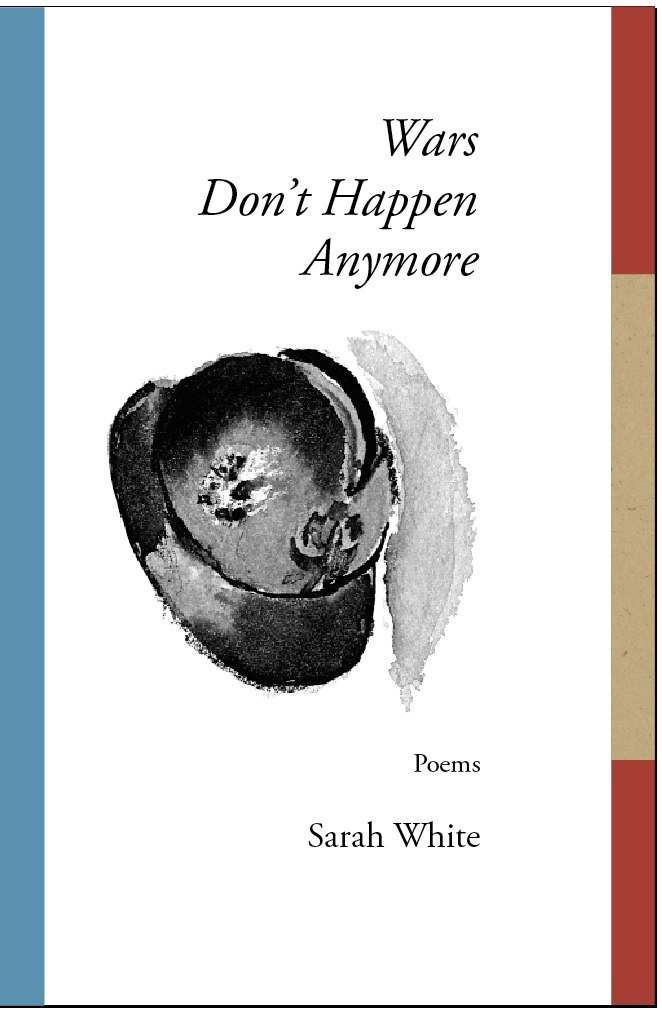
Wars Don't happen Anymore by Sarah White

Sarah White’s poems resonate the irony of glory and human love.

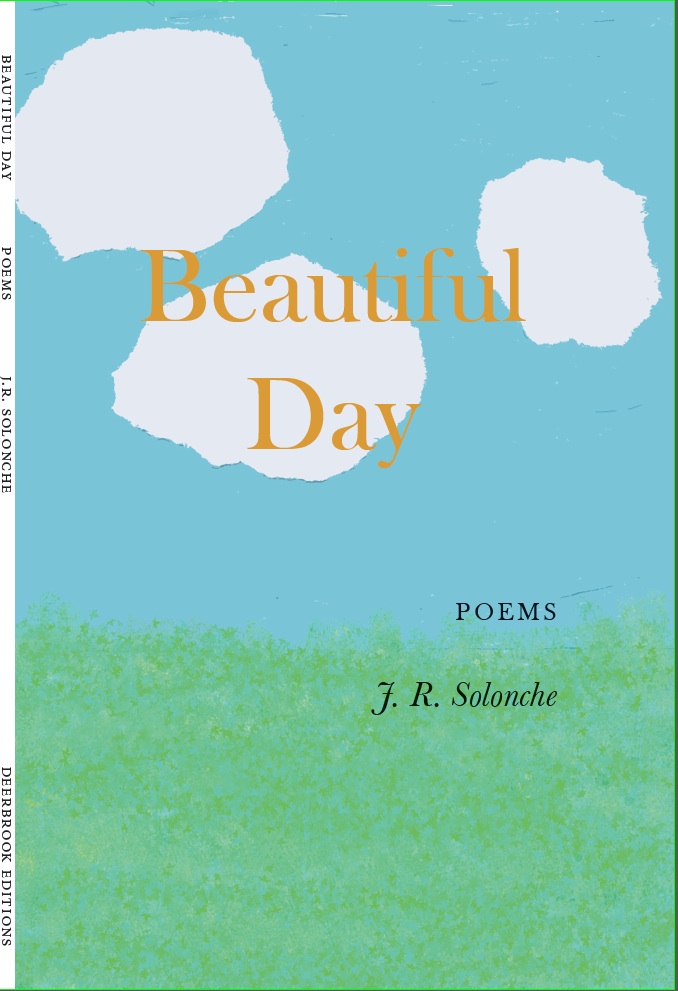
Beautiful Day by JR Solonche

Beautiful Day by JR Solonche has delight and sorrow, insights and more.

Poetry is like getting dropped off in New Orleans.

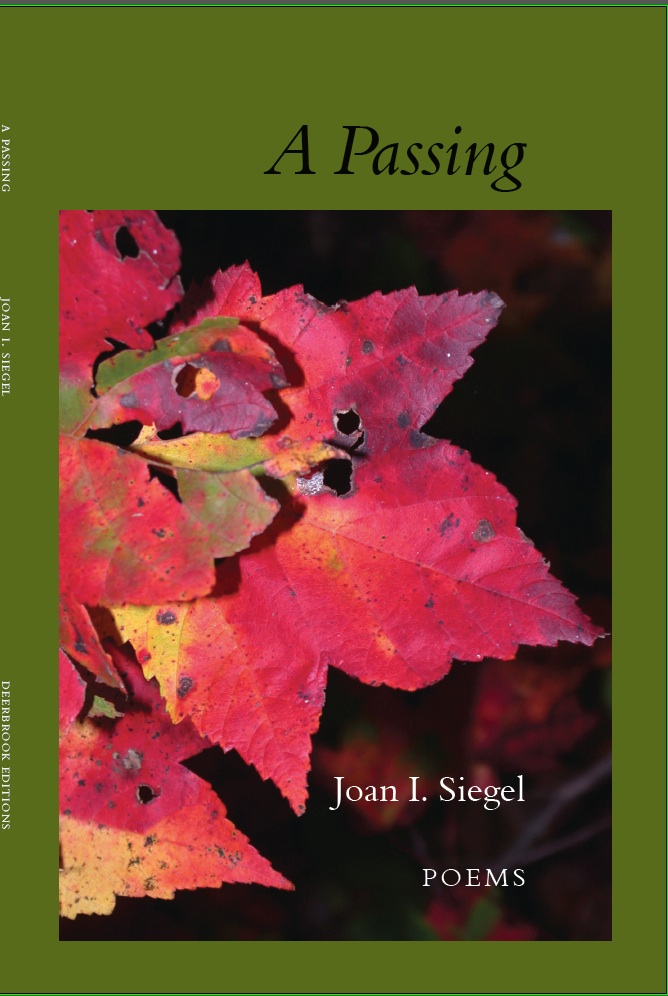
A passing by Joan I. Siegel

Meditations on what cannot be seen, the music of memory.

The birds can sing and I get them.

writing for peace

 Djelloul Marbrook, author of Brushstrokes and glances, sent me this link to a new poem on writingforpeace.org. Djelloul also has an excellent new poetry collection called Brash Ice from Leaky Boot Press.

But except in dreams

we are never really free. As the song goes. Don’t dreams have a way of working for us creatively and by sorting out big questions of the self? Interpretations are best left to the dreamer and not those who want to make symbols and apply them as meanings to be used again as from a dream dictionary. That is not to say that images will not turn up from ideas, memories, ancient art, alchemy, initiations, stories, and myths. They can make questions bigger or show us something we pondered about in more simple terms, whether or not they actually answer any questions at all, it may be enough to be engaged in thinking about our lives from a dream perspective.

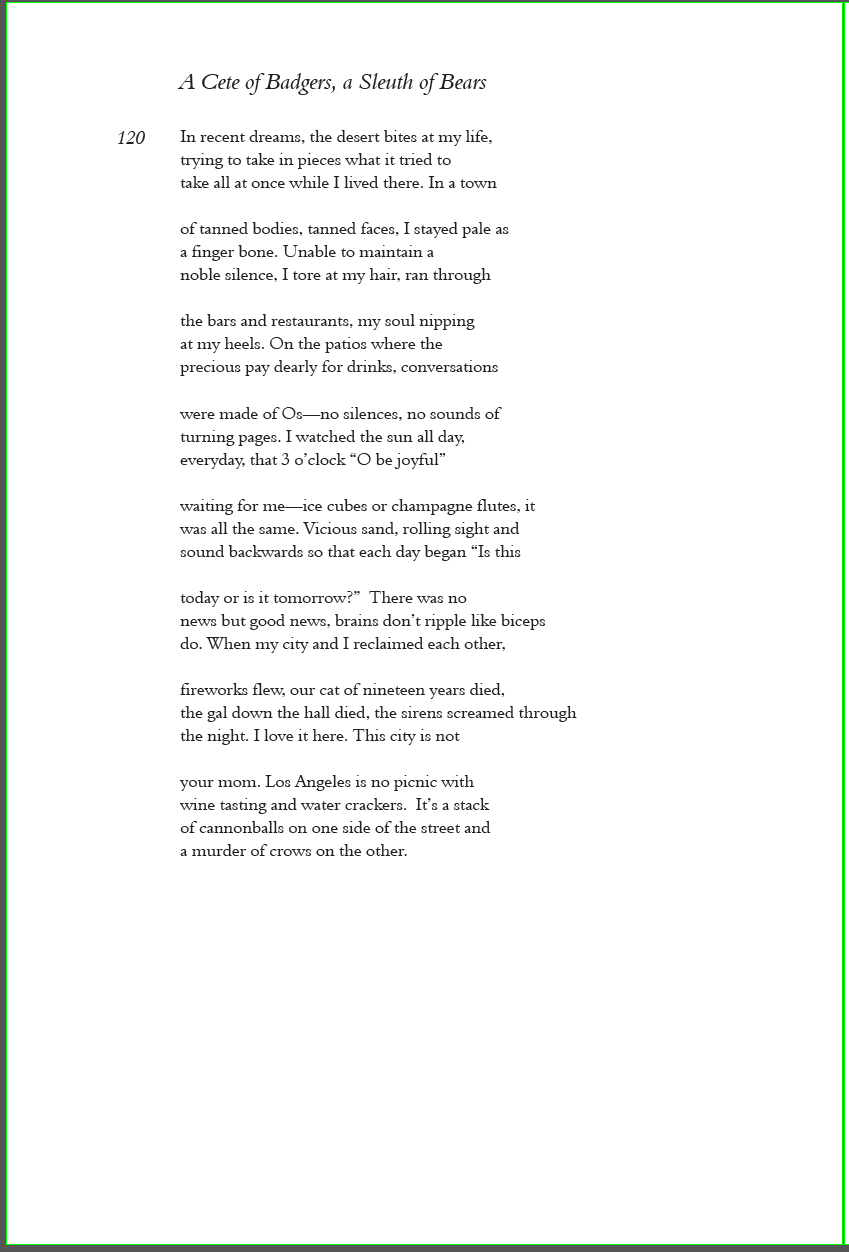
Here is a favorite poem from Where it Goes by Martina Reisz Newberry.

A Cete of Badgers, a Sleuth of Bears